


Highlights
Canadians want more affordable housing, not just more housing. When forced to choose between competing housing policy priorities, Canadians were most likely to prioritize secure, affordable rentals (41%), followed by housing people without homes (37%) and lowering housing costs, even if property values fall (35%). Simply building more homes, regardless of type, size, or location, ranked much lower.
Most Canadians are willing to see home prices fall. But not everyone. Renters overwhelmingly favour lower housing costs over protecting property values, as do homeowners under 50. The exception? Homeowners aged 50 and older, who are slightly more likely to prioritize protecting property values (27%) than lowering housing costs (22%).
Housing affordability could be a political opportunity, particularly among non-voters. Housing priorities vary by political affiliation, but one finding stands out: non-voters were the only group to select a single priority as most important at least half the time, choosing lower housing costs even if property values fall. For political parties looking to engage potential voters, that is a finding worth paying attention to.
Canadians don’t prioritize protecting property values. Well, mostly
In “Canadians Don’t Care How Many Homes We Build,” we saw that our poll of over 4,200 Canadians, conducted by Data Sciences Inc., showed that when it comes to the goals of housing policy, Canadians tend to think in terms of outcomes (e.g. “rents holding steady or coming down”) rather than outputs “a lot more homes being built”). Methodological details about the poll can be found here.
Today we’ll show that Canadians want housing policy to prioritize falling rents and home prices. To a point. And that viewpoint is not universally shared.
In the words of Data Sciences: “If asked to rate housing priorities, people will say nearly everything is ‘important." So we made them make trade-offs instead.”
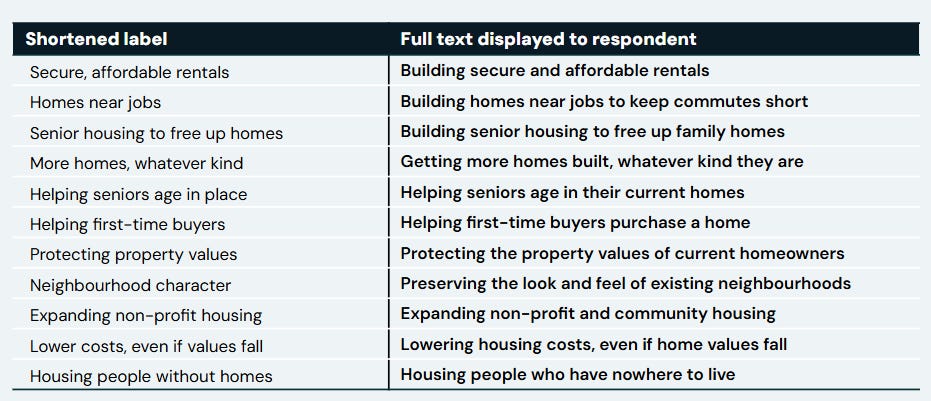
We created a list of 11 potential housing policy priorities, from “building secure and affordable rentals” to “preserving the look and feel of existing neighbourhoods”.
Figure 1: Possible housing policy priorities
Source: National Bilingual Baseline Study
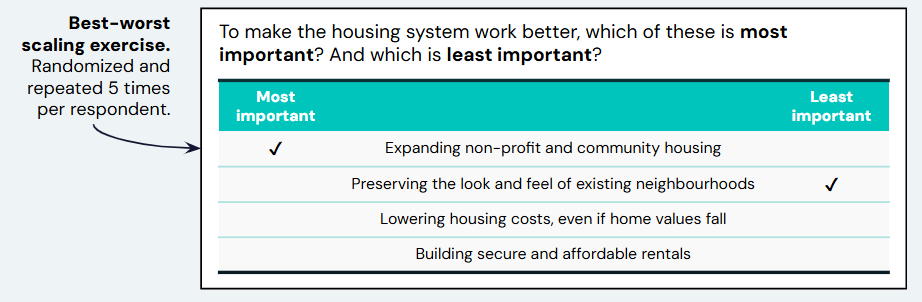
To force a prioritization, four of the priorities were chosen at random, and each participant was asked, “[t]o make the housing system work better, which of these is most important? And which is least important?” Each respondent performed this exercise five times, with the options randomized each time.
Figure 2: Prioritization exercise
Source: National Bilingual Baseline Study
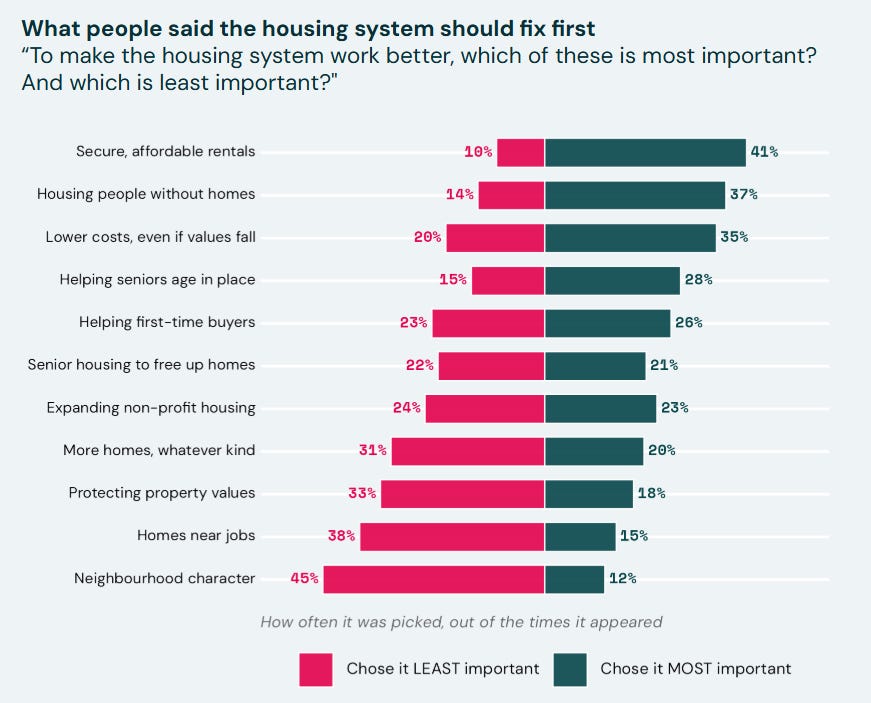
Of our 11 options, “secure, affordable rentals” was the most likely to be selected as the most important priority (41%) and the least likely to be selected as the least important (10%), a 31-point gap. Three other options had a positive gap of over 10 points: “housing people without homes (37 vs. 14), “lower costs, even if values fall” (35 vs. 10) and “helping seniors age in place” (28 vs. 15). Since two of these four options relate to affordability, it is fair to say that Canadians see the importance of falling prices and rents.
Similarly, four options had a 10-point or greater gap between respondents selecting them as least important and those selecting them as more important. These include “neighbourhood character” (chosen as least important 45% of the time, vs. 12% of the time chosen as most important), homes near jobs (38% vs. 15%), protecting property values (33% vs. 18%), and “more homes, whatever kind” (31% vs. 20%). The last one is particularly noteworthy, as many governments across Canada, including both the federal government and the province of Ontario, express their goals in terms of the quantity of homes built, with no differentiation on the type, size, affordability, or location of those homes.
Figure 3: Results of the trade-off exercise.
Source: National Bilingual Baseline Study
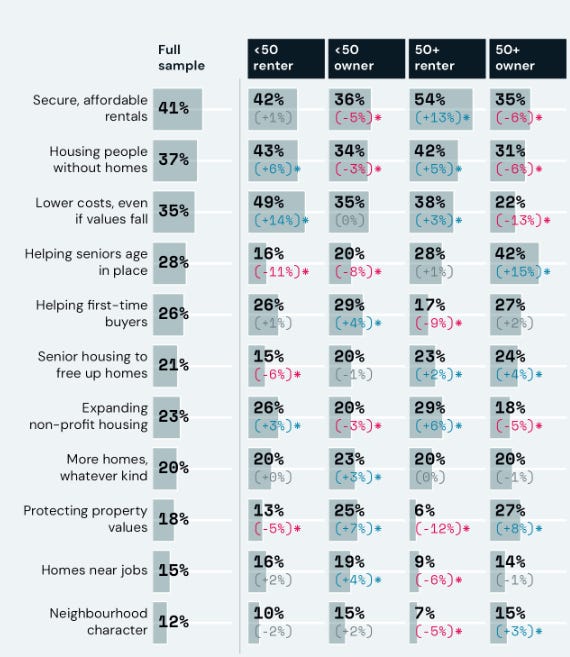
The sample size of the poll is large enough to allow us the sample to be subdivided in any number of dimensions. As with the previous piece, we subdivide the results by age (under 50 or 50+) and tenure (renter or owner), creating four different groups. For three of our groups, “lower costs, even if values fall” is more likely to be chosen as the most important than “protecting property values.” These differences are particularly large for renters, with a 49% vs. 13% split for renters under the age of 50, and a 38% to 6% split for renters who are 50+. Even younger owners are more likely to suggest that “lower costs, even if values fall” should be a more important goal than “protecting property values”, 35% to 25%.
The one group where this relationship does not hold is homeowners 50 or older, with lowering costs chosen only 22% of the time, compared with protecting property values at 27%.
Figure 4: Results of the trade-off exercise by respondent age and tenure.
Source: National Bilingual Baseline Study
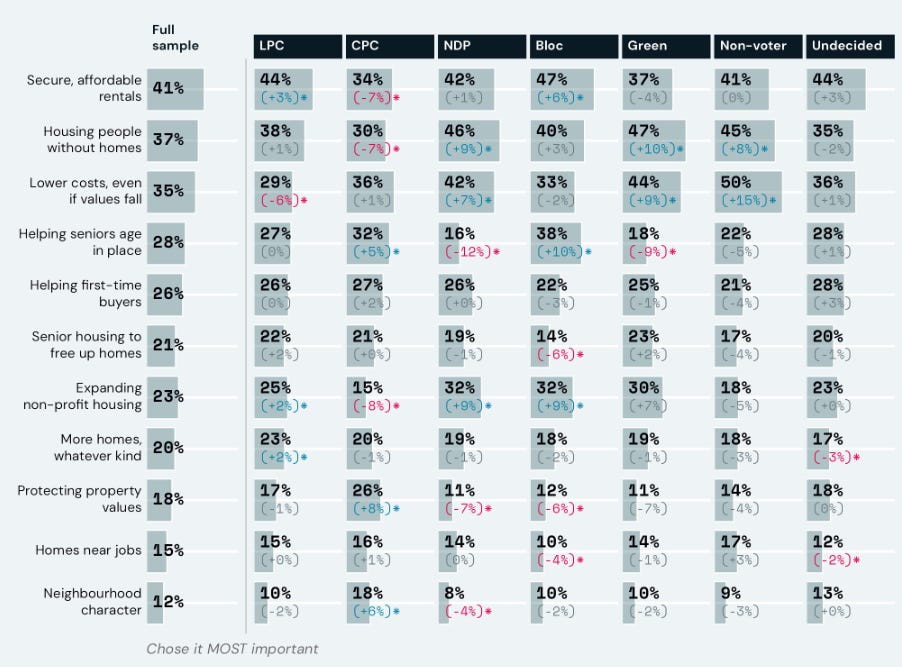
We can also divide the sample based on the respondent’s federal voting intentions. Unsurprisingly, there is a relationship, often large, between a person’s voting intentions and their views on what housing policy should prioritize, though this relationship should not be overstated. Liberal and Bloc voters are more likely to prioritize “secure, affordable rentals”; Green and NDP voters are more likely to “prioritize housing people without homes” and “lowering costs, even if values fall”; and Conservative and Bloc voters are more likely to prioritize “helping seniors age in place”.
Interestingly, only one group chose a particular priority 50% or more of the time as most important: non-voters choosing “lower costs, even if values fall”. Parties could interpret this result in one of two ways: they could downweight the priority, as this group is less likely to vote, or they could upweight it as a priority to attract this group of non-aligned potential voters.
Figure 5: Results of the trade-off exercise by federal voting intentions
Source: National Bilingual Baseline Study
In short, on average, Canadians are more likely to prioritize making housing more affordable than protecting property values, but opinions differ substantially by age, partisan political preferences, and whether they own a home.