
Highlights
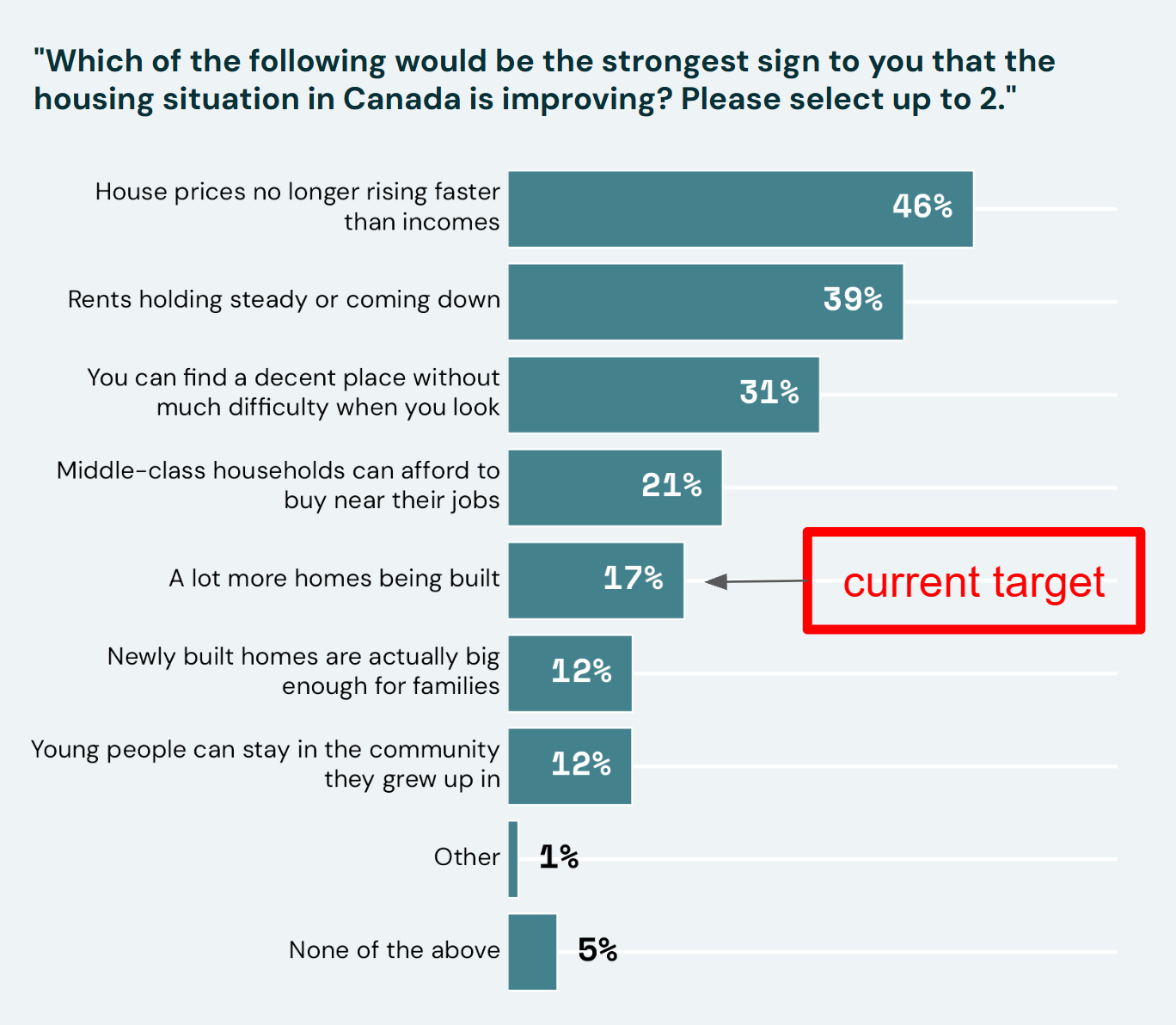
Politicians think in terms of housing starts. Canadians think in terms of affordability and choice. A new Homes and Growth Coalition survey of over 4,200 Canadians finds that falling home prices, affordable rents, and the ability to find suitable housing are the clearest signs of progress. Only 17% selected “a lot more homes being built” as their strongest indicator of success.
Canadians have different housing priorities, but far more unites them than divides them. Renters, homeowners, younger and older Canadians, and residents of our largest cities place different levels of emphasis on rents, home prices, housing size, and location. However, across demographic and financial groups, affordability and availability consistently matter more than housing construction numbers.
Building more homes is a means to an end, not the end itself. Increasing housing supply is essential, but governments need to stop treating housing starts as the ultimate measure of success. Instead, they should set targets based on the outcomes Canadians actually care about: affordable homes, reasonable rents, and having a range of suitable housing options in the communities where they want to live.
Talking to Canadians
In an effort to better understand the viewpoints of Canadians when it comes to the housing crisis, the Homes and Growth Coalition commissioned Data Sciences Inc. to conduct a National Bilingual Baseline Study of over 4,200 Canadians. Details about the poll are on the bottom of this page.
Over the coming weeks, we will be posting findings from that study.
Today’s finding can be summarized as: Politicians speak in terms of housing supply, the general public thinks in terms of affordability and choice.
A disconnect between the political class and the middle class
When it comes to key performance indicators in housing, Canadian politicians and governments love their housing start targets. Ontario has a 1.5 million homes in 10 years target, the federal government has committed to doubling annual housing starts by 2035, and so on. They are less comfortable speaking in concrete terms about affordability, particularly when it comes to the price of homes.
To understand how Canadians viewed what success looks like when it comes to housing, participants in the survey were asked the question “Which of the following would be the strongest sign to you that the housing situation in Canada is improving?” and given seven specific options, with the additional options of “other” and “none-of-the above”.
Three of the seven options were selected by over 25% of respondents, with the top two referring to the price of homes and rents, and the third being about the ease of finding suitable housing options. The supply option, “a lot more homes being built”, finished in fifth place, with 17% support, as shown by Figure 1.
Figure 1: Responses to the question “Which of the following would be the strongest sign to you that the housing situation in Canada is improving?”
Source: National Bilingual Baseline Study
To be clear, none of this should be taken to mean that policies to increase supply are unimportant; after all, increasing the number and diversity of housing options, all else being equal, increases the chances of finding a decent place without much difficulty, and puts downward pressure on prices. However, the general public views building more housing as a means, not as an end.
The general public, for the most part, don’t care what the housing starts numbers are, and what direction they are moving in. The issues they care about are better described by metrics such as average rents, home price-to-income ratios, vacancy rates, and so on.
This disconnect suggests that governments are using entirely the wrong metrics for their targets and key performance indicators, and they would do well to instead think in terms of the housing numbers that matter to Canadians.
Canadians are not a monolith
Because the study has such a large sample size, the data can be sliced and diced into different demographic groups, to see how the views of Canadians differ based on a variety of personal characteristics.
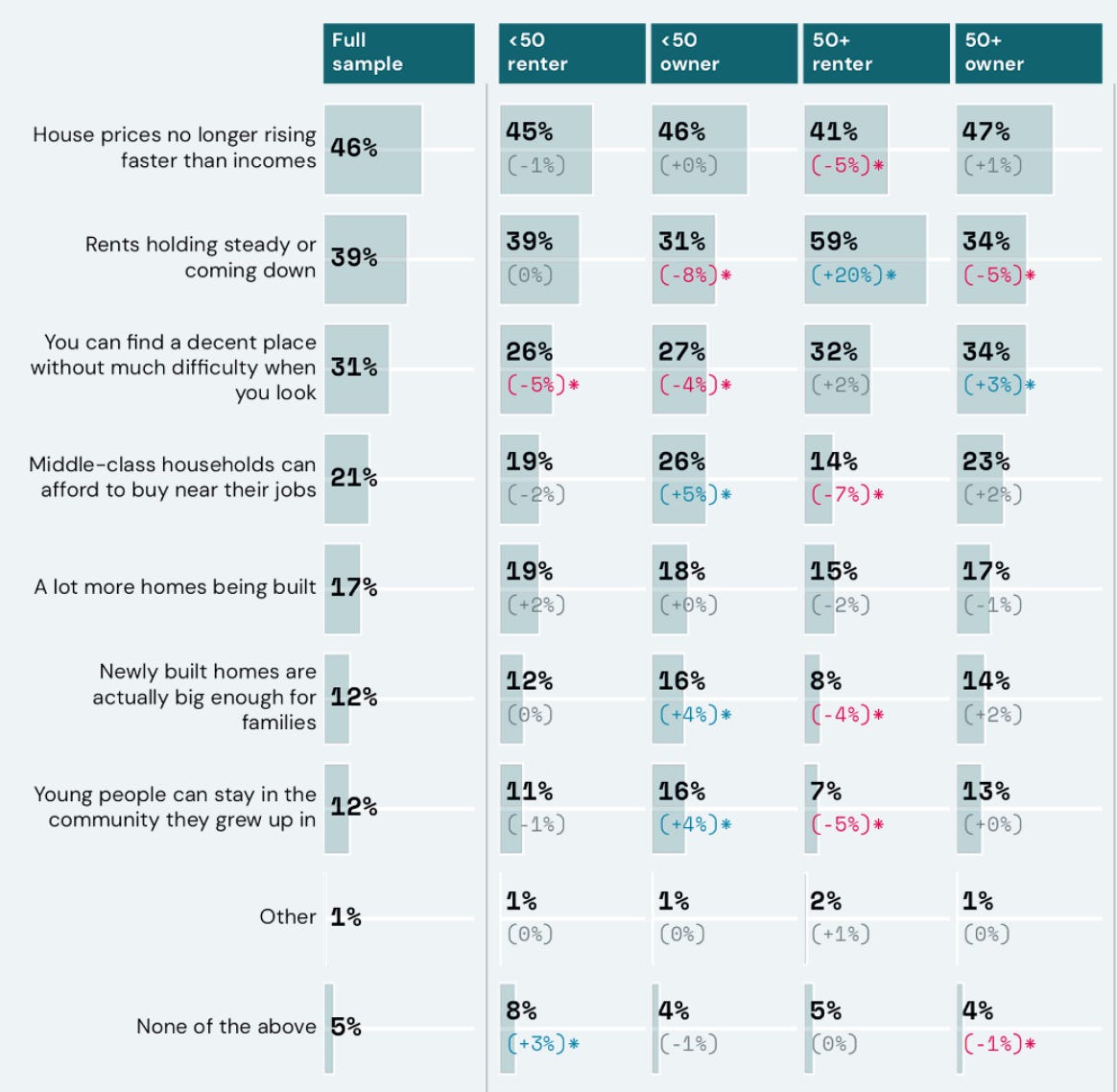
One way to slice the sample is by age (under 50 or 50+) and tenure (renter or owner). Figure 2 shows the results of disaggregating the survey samples into four groups across these two dimensions. These results cover around 86% of the sample, as the remainder of respondents are neither renters nor owners.
There are some differences in the subgroups relative to the population as a whole, with differences that are statistically significant shown in either red or blue. Key points of differentiation include:
Older renters (but not younger ones) view steady and falling rents a more important indicator than the general population, and owners (both older and younger) view it as less important, though in all cases it remains a top-two indicator.
Younger Canadians put less of a priority on being able to find a decent place without too much difficulty, than do older Canadians.
The biggest differences tend to be between younger owners and older rents. Younger owners put more emphasis than the general population on middle-class households being able to buy a home near their jobs, homes being large enough to house families, and young people being able to stay in their communities, whereas older renters de-emphasize these relative to the typical Candian.
Figure 2: Responses to the question “Which of the following would be the strongest sign to you that the housing situation in Canada is improving?” by age and tenure
Source: National Bilingual Baseline Study
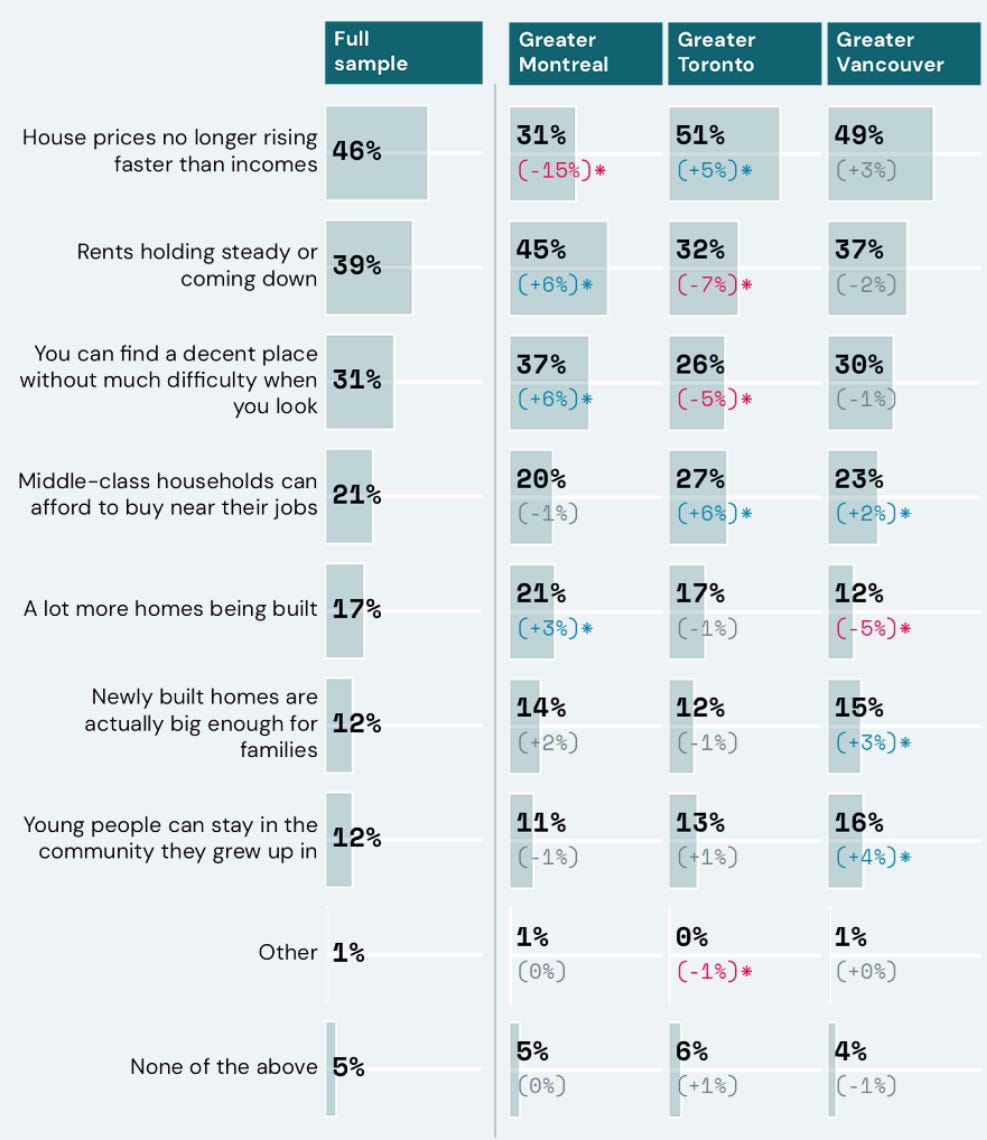
The sample-sizes in the survey were large enough to get results for the Greater Montréal, Toronto, and Vancouver areas. Montrealers emphasized rental affordability and the ability to easily find a decent place more than the average Canadian, whereas Torontoians emphasized home prices and middle-class households being able to live near where they work. The responses of Vancouverites were closest to the average of the sample, though they placed a heavier emphasis on home size and young people being able to live in the community they grew up in.
Figure 3: Responses to the question “Which of the following would be the strongest sign to you that the housing situation in Canada is improving?” by geography
Source: National Bilingual Baseline Study
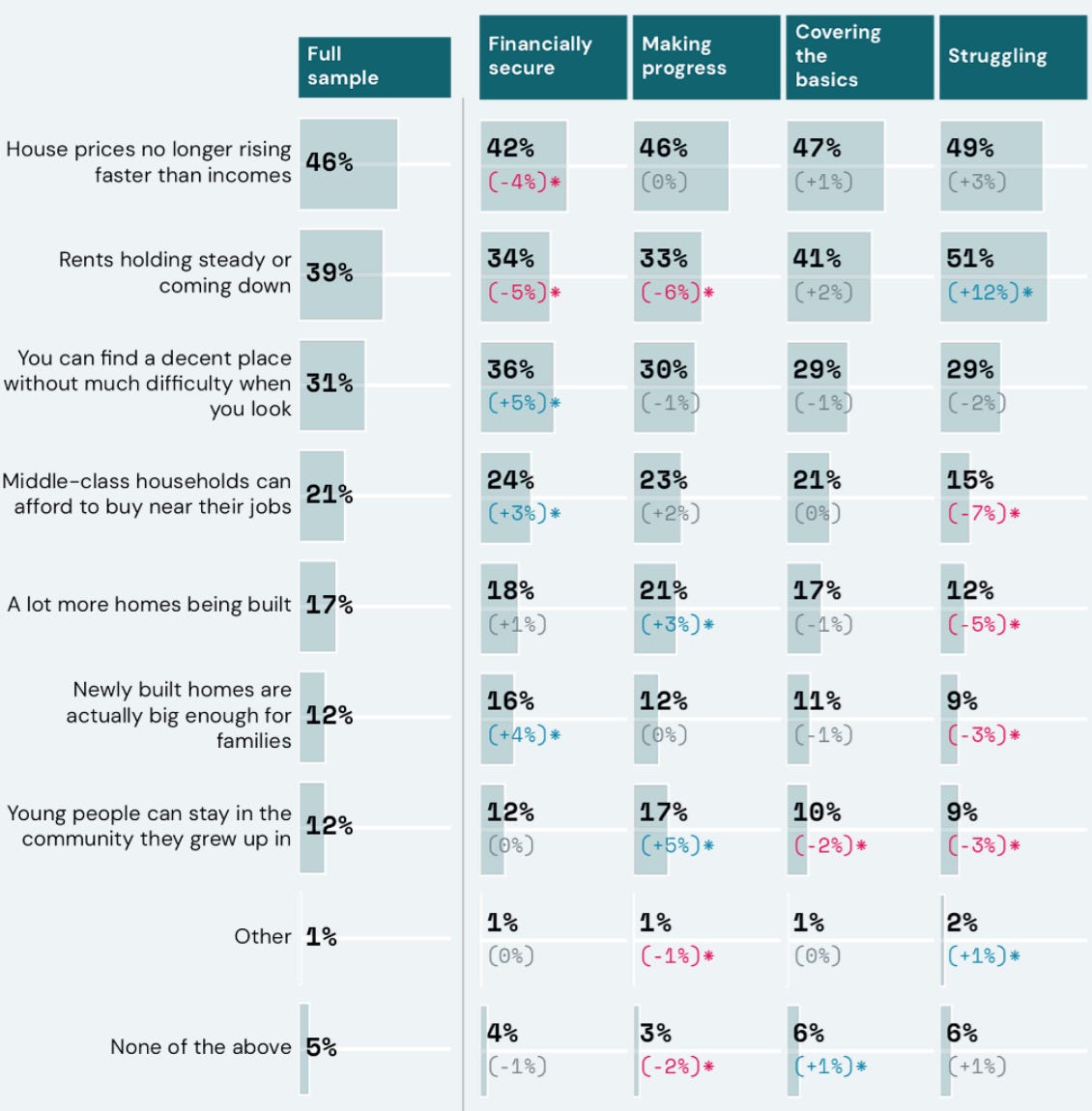
We’ll leave you with one final chart. Participants were asked about their subjective financial situation, and grouped into one of four categories: financially secure, making progress, covering the basics, and struggling.
Not surprisingly, those in the “struggling” camp placed a far greater emphasis on rents than the average Canadian, and far less emphasis on housing supply, proximity to jobs, and the size of homes. The reverse was true for those who are financially secure. These results can be overstated, however, as the rank ordering of these priorities is nearly identical across the four groups.
Figure 4: Responses to the question “Which of the following would be the strongest sign to you that the housing situation in Canada is improving?” by subjective financial situation
Source: National Bilingual Baseline Study
The big takeaway from all of this is that, when it comes to housing, Canadians think in terms of affordability and availability, not increasing housing starts. Politicians should be mindful of this when setting future housing targets and key performance indicators.
Details about the study
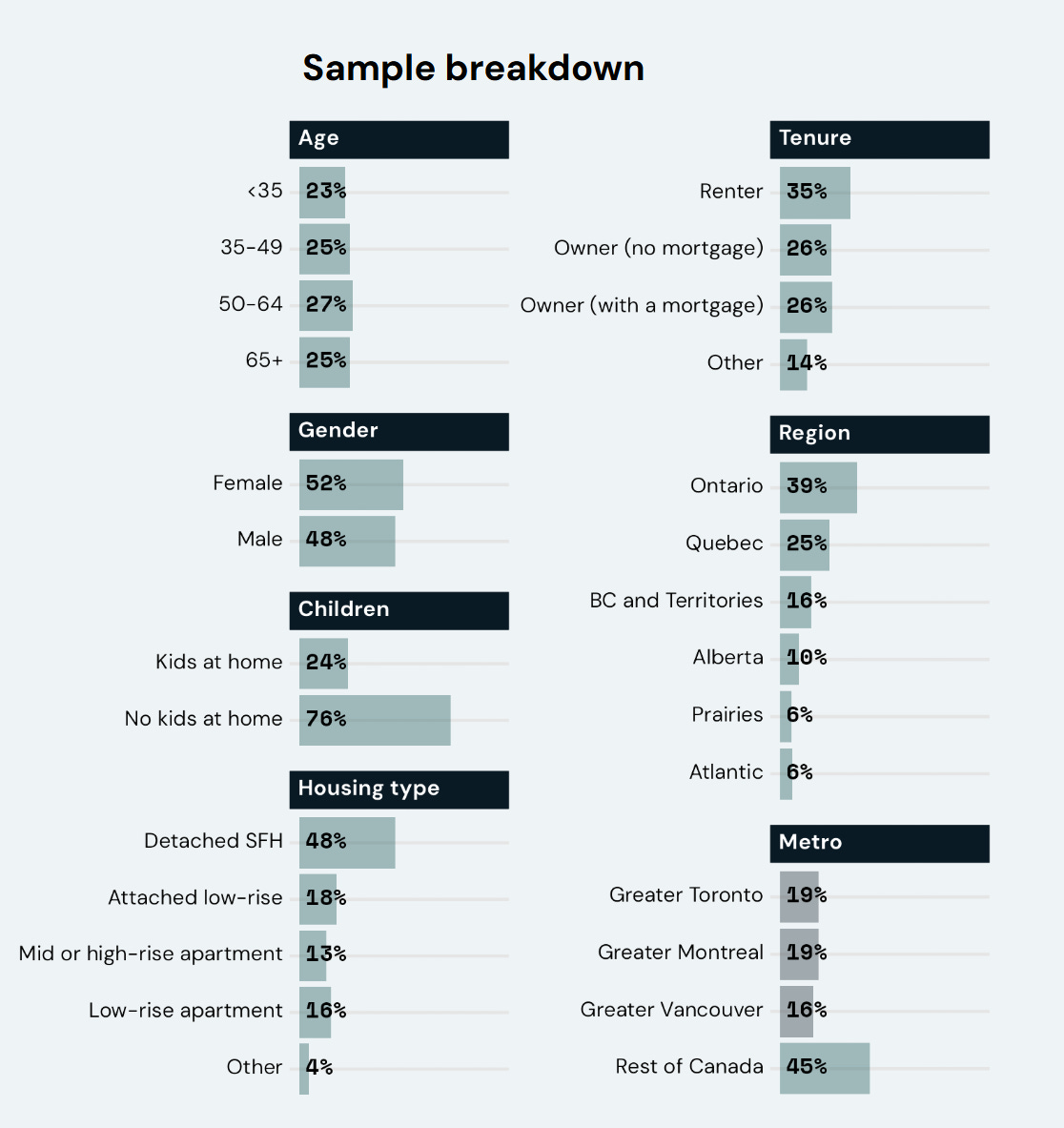
A total of 4,245 Canadian adults participated in the study, and were surveyed online between September 3rd and 21st of 2026. Three geographies were oversampled to better understand the viewpoints of Canadians in Canada’s three largest metros. Greater Toronto (n = 1,000), Greater Montreal (n = 1,000) and Greater Vancouver (n = 901) were oversampled; with 1,388 respondents were outside the three metros.
For the national numbers, responses were weighted to national population statistics, based on gender, region, age, language, and education, to ensure the results were reflective of the Canadian population.
Figure 5: Sample breakdown of participants in the National Bilingual Baseline Study