


Highlights
The Homes and Growth Coalition is accelerating its work, bringing together partners from across Canada’s housing supply chain to develop a comprehensive, evidence-based housing policy blueprint, scheduled for release in Spring 2027.
Budget 2026 provides an opportunity to turn housing policy ambitions into action. With the federal government expected to fill in key policy gaps in 2027, the Coalition aims to deliver its blueprint in March or April, in time to help inform the next round of federal housing reforms.
We have identified five priority areas for policy reform: attracting investment capital, simplifying taxes and fees, modernizing and harmonizing regulations, enabling modern methods of construction, and improving housing data and information. Each is essential to building more homes, at a lower cost, that better meet the needs of Canadian families.
There is no one-size-fits-all solution to Canada’s housing crisis. Building more high-rise rental apartments, missing-middle homes, and family-sized ownership options will require different policy tools. Our blueprint will recognize that a diversity of Canadian families requires a diversity of housing options.
Coming next: What do Canadians actually want from their housing system? The Coalition will be releasing findings from a national bilingual survey of over 4,200 Canadians, examining what homes people want, what they should cost, and what Canadians would consider a successful housing system. After all, good housing policy needs to be both economically sound and politically achievable.
Re-introducing the Homes and Growth Coalition
Welcome to the new Homes and Growth Coalition substack!
Informed by the release of last week’s federal budget, the Homes and Growth Coalition will be accelerating their activities to create a comprehensive housing policy blueprint, for release in Spring 2027, prioritizing areas where governments have shown a willingness to enact reforms.
What is the Homes and Growth Coalition?
The Homes and Growth Coalition brings together partners from across the housing supply chain to develop evidence-based, market-oriented solutions to address Canada’s housing crisis, based on a set of eight principles.
To inform the work of creating a comprehensive policy blueprint, the work of the coalition includes:
Original policy research: Evidence on what and how to build, where, and at what cost, and the reforms that will make that possible. Policy work built to reach the public, not to sit in a drawer.
Convening: Monthly partner meetings, an in-person roundtable in Ottawa, and a national housing summit that puts partners in the room with decision makers.
Public opinion data: Original research on where Canadians actually are on housing, so the plan is built on what governments can adopt, not only on what works on paper.
The Homes and Growth Coalition is led by a secretariat, consisting of Mike Moffatt as the policy research and authoring lead, Canada 2020 as the convening lead, and Data Sciences Inc. as the public opinion research lead. The Members of the Coalition span the breadth of Canada’s housing supply chain.
As of November 9, 2026, the following ten organizations are Members of the Homes and Growth Coalition:
More members will be added in the coming months.
How the Federal Budget informs the work of the Coalition
The Missing Middle Initiative recently had a piece on the new housing policy framework that the federal government adopted as part of Budget 2026. The framework makes it clear that there still exists a number of policy gaps, as well as the connective tissue that binds various housing policy initiatives together.
We expect the federal government to fill in these policy gaps in 2027, as part of the 2027 Spring Economic Update (expected in late April or early May), and in Budget 2027, to inform a future national housing strategy. As such, the Coalition is looking to have our Blueprint complete in March or April of 2027, in advance of the Spring Update.
We have identified five areas, in particular, in need of policy thinking, though the Blueprint will cover areas beyond these five.
Capital attraction: A 2025 RBC report estimates that Canada needs to attract $2 trillion to address Canada’s housing shortage. This capital is need for homebuilding, for housing-enabling infrastructure, to scale up Canadian firms from materials production to modern methods of construction, and to renovate existing homes to support the needs of an aging population. Governments simply do not have enough capital to do this on their own, so they must create the conditions to attract and retain this capital, and ensure other measures do not inadvertently block investment into new housing.
Tax reform and simplification: Taxes, fees, and charges, from tariffs on homebuilding materials to development charges can add 30 percent or more to the cost of a new home. The regulatory burden of some of these taxes, such as the GST/HST self-supply rules on purpose-built rental construction can be quite onerous. Addressing our housing challenges requires reforming and streamlining these rules while also being mindful of the fiscal constraints of governments.
Regulatory modernization and harmonization: Outdated or poorly designed provisions in zoning by-laws, the building code, and technical standards like those for elevators, make our housing more expensive, and less livable, than it otherwise would be. The book Impossible Toronto, for example, outlines a series of rules that make high-quality European homes illegal (“impossible”) to build in the City of Toronto. Regulatory differences between municipalities, or between provinces, prevent modern methods of construction from scaling. Outdated permitting systems create delays in approving, or correcting, applications, adding unnecessary time and cost.
Enabling modern methods of construction: The federal government has sent clear signals that increasing the adoption of modern methods of construction is a top priority. However, a number of barriers exist preventing the scaling up of Canadian technologies and firms in this space, as outlined by the report The Innovation Agenda for Canadian Real Estate. Governments must identify the barriers to adoption and growth, and design policies to address them.
Data, information, and expectations: Canada lacks quality, real-time data on the housing system, which prevents us from understanding what is working well, and what is not, in terms of housing reforms. We lack detailed, centralized information on development charges, permit approval speeds, and pre-construction housing sales. But our dysfunction extends beyond that, as policymakers lack information about the types of reforms that are, and are not, acceptable to the Canadian public. There is a lack of understanding on what Canadians expect from their housing system. Meanwhile, housing policy advocates speak in terms such as “single-egress” and “point-access blocks” which are incomprehensible to the public and most policy makers. To build better, more attainable homes, we need better data, a better understanding of the preferences of Canadians, better terminology, and be able to show policymakers and the public how homes can be made more livable, and more affordable, through the reforms outlined in the first four areas.
All of these areas must recognize the diversity of Canadian families creates the need for a diversity of housing options, including both rental and ownership, across a variety of typologies (see Figure 1). Accelerating the construction of attainable high-rise rental may require a different set of policies than building missing-middle ownership-based options, so a suite of measures are needed.
Figure 1: Housing Typologies
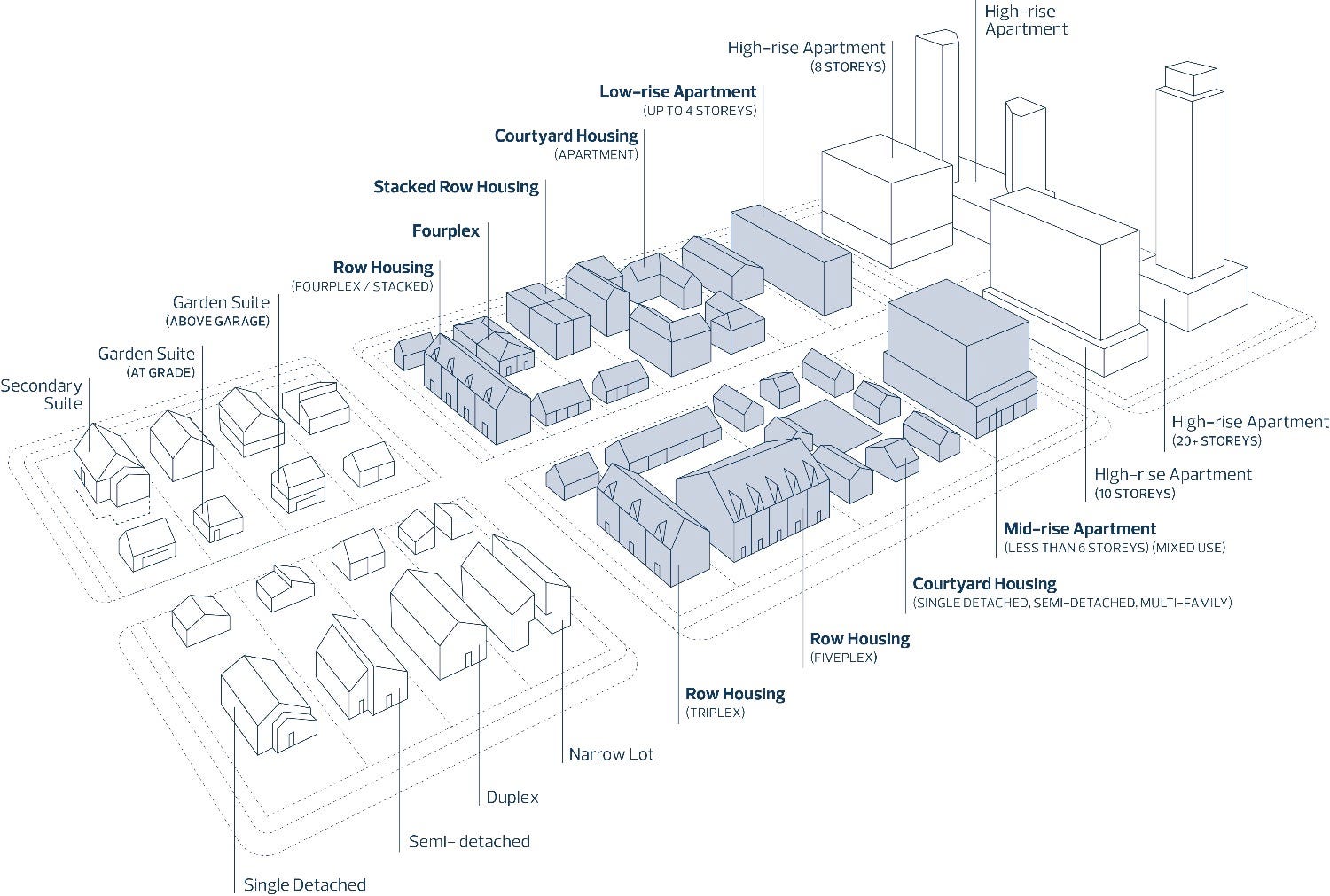
Image Source: Canadian Architect.
Coming next: How Canadians view housing affordability
As part of the work of the Coalition, Data Sciences Inc. conducted a National Bilingual Baseline Study, polling over 4,245 Canadians, covering the following four topics:
Where Canadians are, and what they want: How secure people feel in their current home, what they plan to do over the next ten years, and where owning sits among their goals in life.
What a working housing system should produce: The outcomes Canadians treat as signs the system is improving, the priorities they choose when forced to trade one against another, and the values underneath.
What homes, for whom, and at what cost: Which building types people would accept near their own home, which households each type is judged to suit, what rules a home out, and what housing should cost.
Who should act, and who is trusted: Whose responsibility Canadians think housing is, and which actors they see as helping or hurting.
It is well-established that Canadians think housing is unaffordable. And while governments at every level have set ambitious housing targets, there is little agreement on what success actually means. Along these lines, the study measures what Canadians would count as a housing system that works: what homes Canadians should be able to access, where, and at what cost.
Instead of testing specific policies or sector priorities, the goal is to identify the outcomes and values that different stakeholders can recognize as legitimate even where they disagree about the mechanisms.
Over the coming weeks, we will be posting findings from this study, which will help inform the future of Canadian housing policy.